How much clearance is needed for a retractable awning?
As a specialist of outdoor shading in WA, I’ve seen firsthand how much of a difference proper clearance makes when installing a retractable awning.
Many issues I’m called out to fix stem from one simple oversight—homeowners not fully understanding how much clearance is needed for a retractable awning before installation.
Clearance isn’t just a technical detail; it’s what ensures your awning operates smoothly, provides effective shade, and lasts for years in our local conditions.
Clearance errors often lead to poor performance, fabric wear, and systems that don’t meet basic retractable awning clearance requirements, especially important in WA, where sun, wind, and sudden weather changes can quickly expose weak installations.
In this article, I’ll walk you through what I look for when assessing a site, including retractable awning space requirements and the most common problem areas to watch for.
I’ll help you plan your space properly and avoid costly mistakes before your awning goes up.
What Is a Retractable Awning?
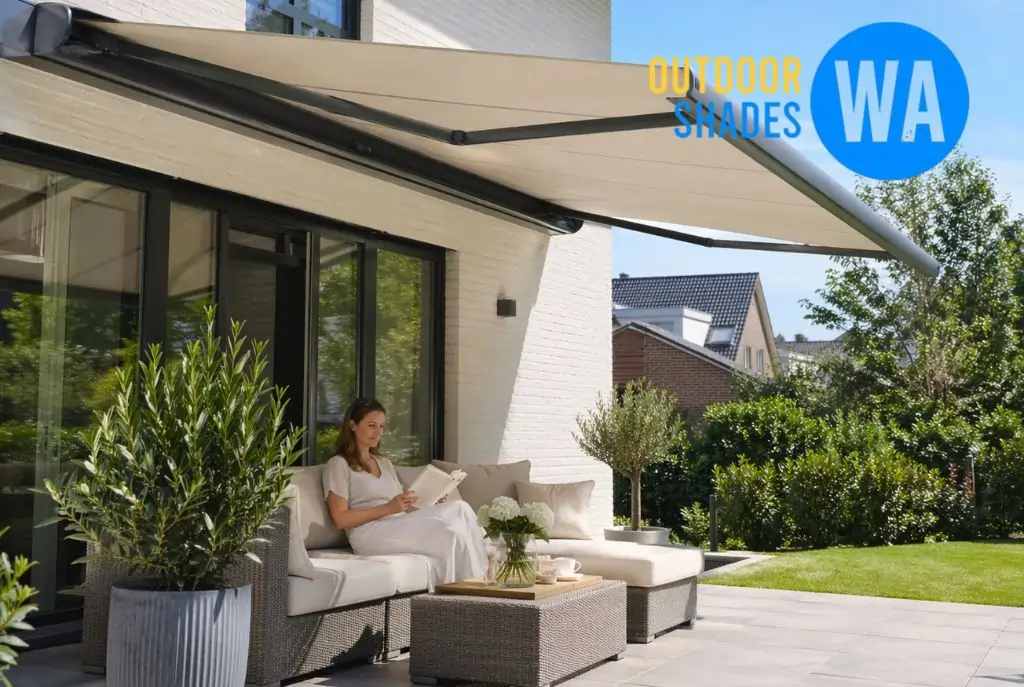
A retractable awning is a flexible shading system installed to provide coverage during bad weather, then retracts without issue when you do not need it.
It operates by using articulated arms that project outward to provide shade over a given outdoor area.
The fabric and arms can be folded back to a compact size when retracted, so they are not exposed to the weather and maintain the sightlines.
Understanding how the moving parts work is the first step in determining how much clearance is needed for a retractable awning.
Once you understand how retractable awnings work, it becomes easier to see why clearance around the arms, fabric, and cassette matters.
The arms have to be given direct free space in the air, up and down, as they stretch and when they return.
That is why manufacturers should specify the clearance requirements for retractable awnings to ensure ease of operation, proper fabric tension, and durability.
Retractable designs most commonly used in both residential and commercial areas are folding arm awnings. This style is favoured because it provides a wide projection range without any use of posts or ground support.
However, the arms open and curve outward, which directly affects the clearance required for retractable awnings.
Why Clearance Matters for Retractable Awnings
The safety and effectiveness of a retractable awning are significantly affected by clearance.
Although this can be seen as a mere measurement, proper spacing has a direct impact on operation, durability, and warranty compliance.
Any discussion around how much clearance is needed for a retractable awning must consider the following.
Safety and User Protection
A retractable awning has arms that are forced out by a spring-loaded or motor-driven mechanism.
In the absence of sufficient space, such moving components may collide with nearby objects.
The appropriate retractable awning clearance requirements minimise the risk of mechanical failure, property damage, and injury when using the product.
Ensuring Full Extension and Smooth Retraction
For the awning to function, it needs a smooth arc for opening and closing.
Lack of space may disrupt this movement, making it jerky or incomplete.
One reason installers take a long time to evaluate retractable awning space requirements is that they use a comprehensive retractable awning clearance guide to determine the proper retractable awning mounting height and pitch angle.
Preventing Long-Term Wear and Damage
When clearance is not planned correctly, several issues can occur over time:
- Fabric rubbing against walls or fixtures, causing premature wear
- Increased strain on arms, brackets, and motors
- Poor pitch angles that allow rainwater to pool on the fabric
Ensuring the appropriate minimum clearance for the retractable awning will help maintain the fabric’s proper tension, assist with water runoff, and minimise stress on mechanical parts.
Meeting Manufacturer and Warranty Requirements
The clearance required for retractable awnings is usually stated in exact measurements by manufacturers, depending on the arm length and projection size.
The specified requirements are not optional: warranty voids and performance loss can result from their violation.
Manufacturers’ installation guides and technical information are used by professional installers to provide appropriate retractable awning installation clearance, especially of motorised outdoor blind systems.
How Much Clearance is Needed for a Retractable Awning
So, how much clearance is needed for a retractable awning?
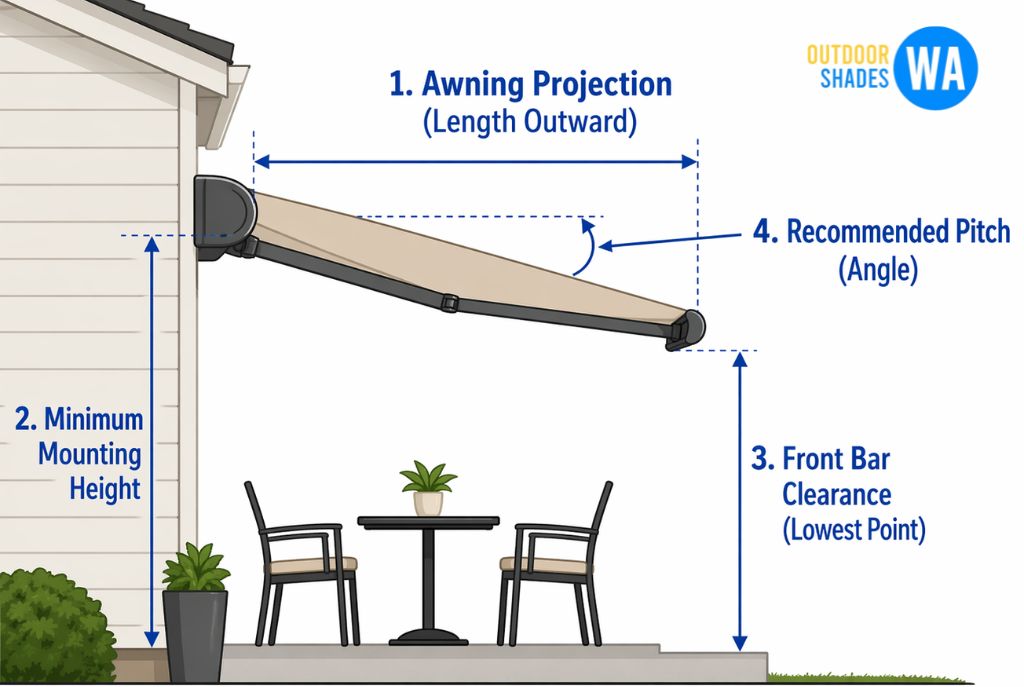
The answer depends on several factors including awning type, projection, pitch (angle), and installation height, especially important in Australian homes where sun angles and weather conditions vary by region.
Below is a practical guide to help you understand how much clearance is needed for a retractable awning in typical settings.
| Awning Projection (Length Outward) | Minimum Mounting Height | Front Bar Clearance (Lowest Point) | Recommended Pitch (Angle) |
|---|---|---|---|
| 2.0 m | 2.3 m | 2.0 m | 10°–15° |
| 2.5 m | 2.5 m | 2.1 m | 12°–15° |
| 3.0 m | 2.7 m | 2.1–2.2 m | 12°–18° |
| 3.5 m | 2.9 m | 2.2 m | 14°–18° |
| 4.0 m | 3.0 m+ | 2.2–2.3 m | 15°–20° |
In Australia, most retractable awnings are installed at a height of 2.5 m to 3.0 m. This allows enough slope for rain runoff and maintains comfortable head clearance.
To ensure effective shading and water drainage, a minimum pitch of 10°–15° is recommended. Steeper angles may be necessary in regions with heavy rainfall.
The lowest point (front bar) should typically be at least 2.0–2.2 m above ground to allow people to walk underneath comfortably.
Because Australia experiences strong UV exposure, especially in northern regions, installing the awning slightly higher with a steeper pitch improves shade coverage.
While retractable awnings usually don’t require council approval, always check local regulations, especially for larger installations or heritage areas.
Quick Rule of Thumb
If you’re still wondering how much clearance is needed for a retractable awning, a simple guideline is:
- Mount at least 2.5 m high
- Allow 300–500 mm drop from back to front
- Maintain minimum 2.1 m clearance at the front
Getting the clearance right is crucial for both comfort and functionality. Understanding how much clearance is needed for a retractable awning ensures proper drainage, optimal shade, and safe headroom.
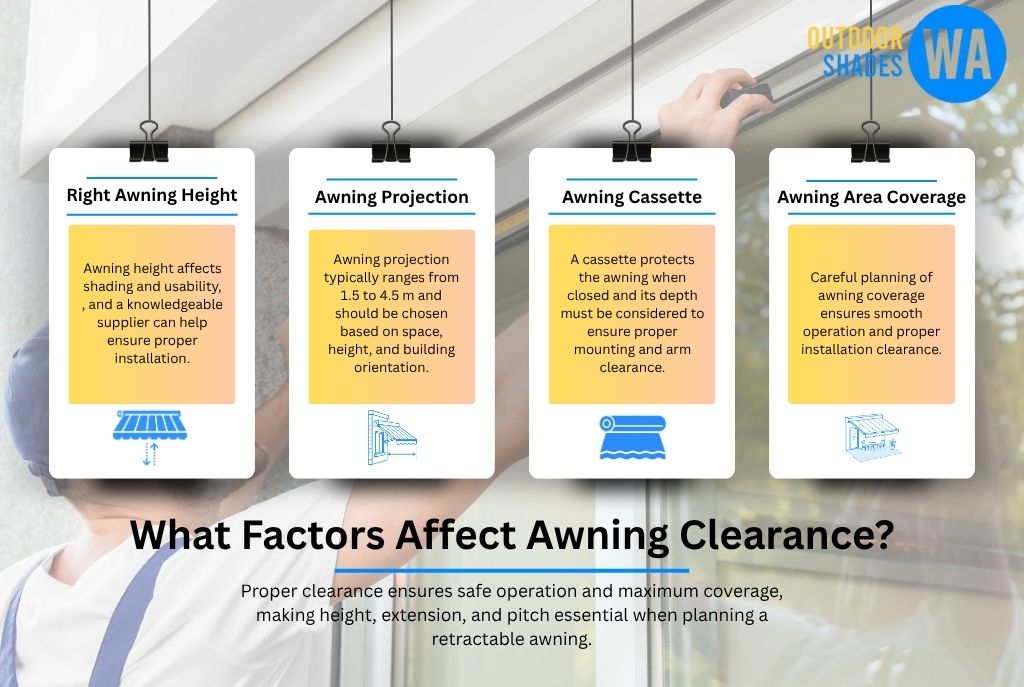
What Factors Contribute to Awning Clearance?
Clearance is also required for your retractable awning to operate properly and improve your outdoor space.
The height, extension and pitch will allow you to plan to ensure the awning is safe and offers maximum coverage.
It is important to know how much clearance is required for a retractable awning to ensure you meet all practical and recommended requirements.
Right Awning Height
The awning height on your house affects its usability and shading performance.
Generally, the minimum clearance for a retractable awning is about 2.4 metres above the ground.
This provides sufficient headroom to walk freely under the awning when fully extended.
Mounting height also affects the total retractable awning installation clearance, the distance that an awning can project without affecting the pitch or fabric tension.
If you are not sure about the right height for your outdoor space, a knowledgeable supplier can help ensure your installation meets the required clearance for retractable awnings.
Awning Projection
The projection, or the distance the awning extends outward, is also a critical factor to be considered to achieve structural integrity and weather resistance.
The projection of most retractable awnings ranges from 1.5 to 4.5 metres, depending on the model.
Selecting the appropriate projection is an important part of determining retractable awning space requirements because the longer the extension, the higher the required height, and the arm should be positioned correctly to ensure safe use.
The size of your outdoor space, the width of your awning, and the direction of your building will be among the factors that determine your ideal projection.
Having a supplier who can design the projection to fit your location is a sure way to comply with a retractable awning clearance guide.
Awning Cassette and Protection
A cassette or hood protects the awning material and hardware during closure, preventing rain, debris, and insects from ruining the material. Full-cassette systems fully wrap the system, which provides extra protection against corrosion and other environmental wear.
The cassette’s depth should be included in your retractable awning clearance requirements, as it influences mounting and the space needed to move the arm without obstruction.
Planning Your Outdoor Area
It is important to carefully plan your awning area coverage to avoid obstacles and ensure smooth operation.
Consider:
- Fixed structures that might block the awning’s full extension
- Patio furniture, doors, and window placement
- Building orientation to optimise sun protection
Proper measurements and consideration of these factors will enable your supplier to advise on and make the correct recommendations for solutions, ensuring that your space complies with all retractable awning installation clearance requirements.
Structural Factors That Affect Clearance
Besides fundamental measurements, the physical layout of your home also significantly affects the amount of clearance needed for a retractable awning.
Fixed building elements may obstruct available space and must be thoroughly evaluated before installation to comply with the retractable awning clearance requirements.
Eaves, Gutters, Downpipes, and Rooflines
These are among the most prevalent parts that are considered barriers to installation. Awnings installed too close to the roof features may not be able to extend or retract properly.
- Gutters and eaves can restrict vertical mounting height and affect the pitch
- Downpipes may interfere with arm movement if horizontal clearance is insufficient
- Rooflines can dictate whether wall, fascia, or ceiling mounting is possible
Considering these factors at an early stage helps meet essential retractable awning space requirements and prevent needless changes.
Installing Near Posts, Beams, or Walls
Clearance can also be affected by outdoor features such as pergolas, alfresco posts, or boundary walls. Folding arms should be prepared in a space as they arc outward.
- Posts or beams positioned too close can block arm extension
- Side walls may limit the usable width of the awning
- Reduced clearance can place strain on the arms and fabric
Using a professional retractable awning clearance guide enables an installer to evaluate those structural impediments and facilitate proper functioning.
Clearance When Combining Awnings with Outdoor Blinds
A combination of a retractable awning and outdoor blinds is one of the methods that are used to make the outdoor environment more comfortable and weather-protected.
However, the planning of clearance becomes more crucial when such systems are layered.
In such installations, horizontal and vertical movement must be taken into account when calculating the clearance needed for a retractable awning.
How Awnings and Blinds Work Together
Retractable awnings can shield from rain, and the sun, and outdoor blinds block wind, low-angle sun, and wet light rain to the sides.
The two systems are complementary when properly installed and can enhance thermal comfort and usability.
Adequate retractable awning clearance requirements will mean that the systems do not limit the movement of the other.
Installing Ziptrak Blinds Beneath a Retractable Awning
When installing Ziptrak blinds below an awning, precise spacing is essential:
- The awning arms must fully clear the blind headbox and side tracks
- Sufficient vertical space is required to allow full blind retraction
- Incorrect spacing can cause arm interference or fabric contact
The use of a professional retractable awning clearance guide helps ensure smooth operation and avoids mechanical stress on both systems.
Using Straight Drop Blinds With Retractable Awnings
Straight drop blinds are often chosen for their simplicity and clean appearance, but they still require careful planning when paired with a retractable awning.
- Blinds should be positioned outside the arc of the awning arms
- Adequate spacing ensures the awning can extend without obstruction
- Proper alignment maintains airflow and fabric tension
The proper minimum clearance between a retractable awning and its surroundings ensures that the two systems can operate independently and collaborate to improve weather protection.
Weather Performance and Clearance
Correct clearance is highly related to weather performance.
It also works together with material choice, which is why many homeowners ask about the best fabric for outdoor awnings before installation.
A retractable awning with insufficient spacing cannot withstand rain or wind.
Understanding how much clearance is needed for a retractable awning helps ensure a reliable system whenever the weather changes.
Rain Runoff and Water Shedding
Correct clearance allows a retractable awning to be mounted at the right pitch, which is crucial for good water runoff.
- Adequate vertical clearance enables rainwater to shed away from the wall
- Insufficient height can cause water to pool on the fabric, adding excess weight
- Pooling water increases strain on arms, brackets, and fabric seams
The proper attainment of the correct slope of water management is achieved by meeting manufacturer-specified retractable awning clearance requirements.
Wind Exposure and Arm Movement
Another issue of clearance concerns wind resistance. The arms of the retractable awnings must move freely and evenly to withstand gusts and safely retract when necessary.
- Restricted space can limit arm movement and increase stress during windy conditions
- Proper horizontal clearance allows arms to flex and retract smoothly
- Motorised systems rely on unobstructed movement to prevent overload
These are standard retractable awning space considerations that are frequently defined in a professional retractable awning clearance guide.
Are Outdoor Blinds Waterproof?
The question “Are outdoor blinds waterproof?” is frequently asked by homeowners, especially when it comes to weather protection.
Although some blinds are made of PVC, which is rain-resistant, many blinds are made of mesh or shade fabrics that allow air to pass but not water.
Clearance also helps here, as proper spacing between awnings and blinds allows water to drain well and prevents moisture from being trapped.

How Proper Clearance Improves Shading Performance
Appropriate clearance not only affects installation but also directly affects the performance of a retractable awning.
With proper planning of the clearance, the awning can provide maximum shade and comfort.
This is one of the factors to consider when determining how much clearance is needed for a retractable awning.
How Clearance Affects Shade Coverage
Proper installation height and distance enable the awning to extend to the most appropriate angle to avoid direct sunlight.
Adequate vertical clearance enables a steeper pitch for better sun control
Proper projection ensures consistent shade throughout the day
Insufficient clearance can limit extension and reduce the shaded area
Awnings, Airflow, and Cooling
Clearance is also very significant in airflow. Awnings that are too close to walls and buildings trap the hot air under the canopy.
- Correct spacing allows warm air to escape naturally
- Improved airflow enhances comfort in outdoor areas
- Reduced heat buildup lessens reliance on mechanical cooling
Do Outdoor Blinds Reduce Heat?
One of the questions homeowners ask is, “Do outdoor blinds reduce heat?”
Yes, as long as long as the outdoor blind is installed properly.
Outdoor blinds can also help reduce heat by preventing heat penetration into glass surfaces before sunlight reaches them.
Blinds can be used to control the temperature, though they can be paired with a retractable awning and fitted with sufficient clearance to allow still air to pass through and maintain the view.
By ensuring the minimum clearance for a retractable awning is met, you maximise shading, improve air movement, and enhance the overall thermal performance of your outdoor living environment.
Planning Your Outdoor Setup
Your retractable awning must be well planned so that it works as expected and complies with all clearance regulations.
Measuring and coordinating the existing systems is another way to determine how much clearance is needed for a retractable awning before placing an order.
Measuring Tips Before Ordering
Accurate measurements form the foundation of a successful installation.
- Measure available vertical height from the mounting point to the ground
- Identify any obstructions such as eaves, gutters, lights, or ceiling fans
- Allow space for arm movement and fabric pitch
These steps ensure your space complies with the standard retractable awning clearance requirements and prevent problems during installation.
Coordinating Awnings With Existing Outdoor Blinds Products
Clearance planning is even more critical when the space you have already has other outdoor blinds products.
- Check the position of blind headboxes and side channels
- Ensure awning arms will not interfere with blind operation
- Maintain adequate spacing for airflow and water drainage
When to Seek Professional Installation Advice
When it comes to basic measurements, homeowners can handle them, but for complicated setups, professional assistance is always welcome.
- Uneven rooflines or limited mounting height
- Multiple systems operating in the same area
- Custom or motorised awnings with strict specifications
An experienced installer will be able to evaluate the retractable awning installation clearance, check the minimum clearance required, and consult an elaborate retractable awning clearance guide to help ascertain compliance and durability.
Ensure Your Outdoor Shading System Performs at Its Best!
Getting the clearance right is one of the most important steps in choosing a retractable awning.
Following the correct retractable awning clearance requirements is essential for safe operation and reliable performance.
Understanding the clearance requirements for a retractable awning helps prevent common issues such as restricted movement, water pooling, and unnecessary wear on fabric and hardware.
Taking the time to confirm the minimum clearance for retractable awning installations can save you from costly adjustments later.
At Outdoor Shades WA, we help homeowners assess their space and select the right solution for their needs.
We offer a wide range of outdoor shading options, including retractable awnings, outdoor blinds, and other custom shade systems designed to suit different structures, lifestyles, and budgets.
Reach out to the team at Outdoor Shades WA for expert advice, accurate measurements, and tailored solutions.
Contact us today to book a consultation and make sure your outdoor shading system is designed to perform at its best.