Outdoor Blinds Costs in Australia: A Comprehensive Guide

Author: Greg Palmer
Greg Palmer is the founder and director of Outdoor Shades WA, a Perth-based business specialising in premium outdoor blinds, awnings, and shade solutions tailored for Western Australia’s climate. With years of hands-on experience, Greg takes pride in delivering custom installations that combine functionality, style, and durability — helping homeowners and businesses create comfortable outdoor spaces they can enjoy all year round.
Disclaimer:
The prices provided on this page are intended as a general guide only and are based on typical industry estimates. Actual costs can vary significantly depending on a range of factors, including the size of the area, product type, materials, customisation options, installation requirements, and site conditions. Prices may also change over time due to supplier costs and market conditions. For an accurate and up-to-date quote tailored to your specific needs, we recommend contacting our team directly.
How much do outdoor blinds cost?
The cost of outdoor blinds in Australia varies more than most people expect. A simple, straight drop blind for a small patio can cost under AUD 1,000, not including installation charges. A fully motorised, track-guided system enclosing a large alfresco area can run well beyond ten thousand. The differences in pricing boil down to several factors, including blind type, size, fabric, hardware quality, and installation complexity.
As suppliers and installers of outdoor blinds across Australia, our team at Outdoor Shades WA regularly speaks to homeowners and business owners who are unsure what they should realistically budget for outdoor blinds when they require them for their space, whether it’s for their home or business.
Of course, you can always go online to get some ballpark figures on outdoor blind prices, but online snippets rarely tell the full story, and comparing quotes can feel confusing if you don’t understand what’s driving costs.
This guide breaks down what different outdoor blinds typically cost in Australia, what affects those prices, and how to avoid paying for features you don’t actually need. The aim of this guide is simple: to help you budget confidently before requesting quotes.
What Type of Outdoor Blind Do You Need?
Not all outdoor blinds are built for the same purpose. Some are designed primarily for sun control. Others focus on wind and rain protection. Some are made to create semi-enclosed outdoor spaces. Some provide privacy without blocking airflow.
So, what do you want your outdoor blinds to achieve for your space?




The right option for your space depends on the structure itself and how exposed it is to the elements. A covered alfresco with solid roofing has different requirements compared to a freestanding pergola or an open deck facing the coast. If your main issue is glare and afternoon heat, a mesh straight drop blind may be sufficient. If you want to block wind-driven rain and create a weather-resistant space you can use year-round, you may need a track-guided system with polyvinyl chloride (PVC) or coated fabric.
Choosing the right type of outdoor blind from the start matters financially. Over-specifying means paying for hardware and features you may never use. Under-specifying often leads to upgrades later, when you realise you need them, which may cost more in the long run, so having a clear understanding of your goals can save both time and money.
Did You Know Outdoor Blinds Could Save You Hundreds?
How Much Do Different Types of Outdoor Blinds Cost?
Outdoor blind prices depend heavily on the system type. Below are typical supply and installation ranges across Australia that reflect current realities. Remember that these are general market estimates. Site conditions, size, fabric selection, and motorisation can push costs up or down.
1. Ziptrak Blinds (Track-Guided Outdoor Blinds)
Ziptrak blinds are premium, track-guided systems that lock fabric into side channels. They are designed to reduce gaps, improve wind resistance, and ensure smoother operation.
‘What’s the typical Ziptrak blinds price?’ you may ask. The following information might help.
📊 Key cost factors:
The size and width of the opening, i.e., larger drops (up to 3.5m) or widths (up to 6m without posts), increase material requirements, as well as fabric choice, motorisation, headbox type, wind rating requirements, structural support, and electrical access for powered models.🏡 Common use cases:
Ziptrak blinds suit outdoor extensions, such as patios, decks, alfresco areas, and pergolas, creating weatherproof, bug-free spaces without the need for renovations. They’re also popular for cafés and restaurants wanting semi-enclosed spaces for expanded seating and residential outdoor areas for shade, privacy, and UV or heat control.✔ Pros:
Strong wind performance, smooth operation, clean finish, and good rain control when installed properly.❌ Cons:
Higher upfront cost, more complex installation, heavier hardware. Ziptrak blinds cost more, but they are generally considered a long-term investment because they offer excellent durability and performance in exposed conditions.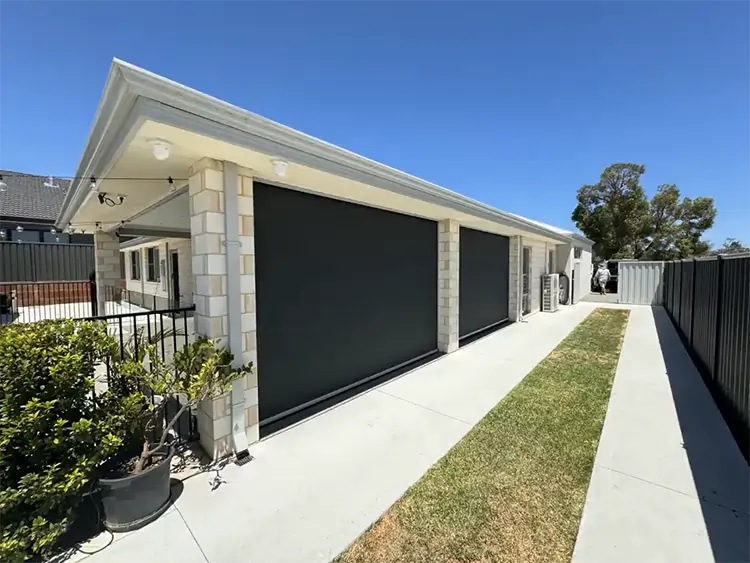
Ziptrak blinds cost more, but they are generally considered a long-term investment because they offer excellent durability and performance in exposed conditions.
➜ Learn more about Ziptrak Blind Costs
2. Folding Arm Awnings (Retractable Awnings)
📊 Key cost factors:
Folded arm awnings prices are affected by the width and projection length (each extra metre can add AUD 300–800 due to the need for more fabric and arms), motorisation, wind sensors, fabric quality (acrylic vs. basic canvas), cassette design, installation height, and customisation.🏡 Common use cases:
These awnings are recommended for use as deck, balcony, and patio shading, courtyard cover, outdoor dining areas (e.g., café verandas), and for shopfront shade protection. They’re also ideal for homes that need flexible sun or UV protection without requiring the setting up of permanent structures, or commercial spots that want to create weather-adaptive outdoor dining spaces.✔ Pros:
Excellent sun control, retractable when not needed, improves energy efficiency by reducing heat gain, stylish, and durable when installed with quality fabrics.❌ Cons:
Higher upfront cost when compared to fixed shades, requires wall-mounting (not freestanding), not designed for heavy rain, water pooling risk, and limited side protection.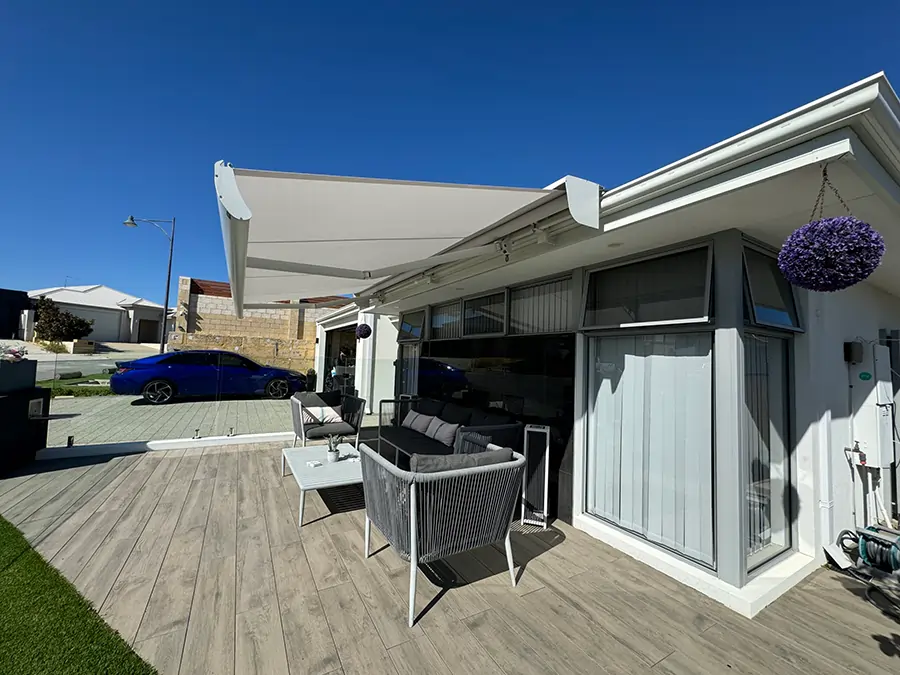
Folding arm awnings are best seen as shading solutions rather than full weather enclosures.
3. Straight Drop Blinds (Outdoor Fabric or PVC)
📊 Key cost factors:
Similar to other types of blinds, size is always a cost driver, and the biggest factor in this case. Other elements, such as the fabric type, PVC thickness, bottom rail design, manual versus motorised operation, mounting surface, and height, can all affect the total cost, plus installation fees.🏡 Common use cases:
These blinds are used to vertically enclose alfresco areas, patios, verandas, and pergolas with existing roofing, and windows. They’re considered a practical entry-level, budget-conscious option that’s popularly used for homes, cafés, and restaurants requiring simple, full-height coverage without roof structures.✔ Pros:
Affordable, simple, versatile, and easy to operate and repair.❌ Cons:
Limited side sealing, fabric can sag without tracks, less wind resistance, limited projection (vertical drop only), and may flap in stronger weather conditions since they’re not designed for exposed coastal areas or high wind zones.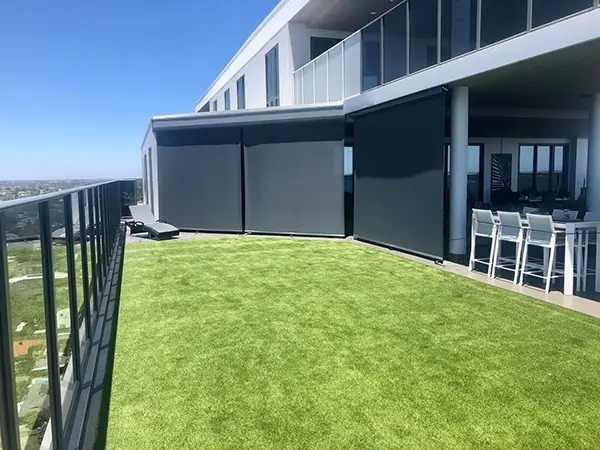
4. Café Blinds (Clear PVC Outdoor Blinds)
Café blinds are typically clear PVC panels used to create a wind and rain barrier while maintaining visibility in outdoor spaces.
📊 Key cost factors:
PVC outdoor blinds cost more or less based on size and area, operation type (manual crank vs motorised), PVC thickness/transparency, stitching quality (e.g., heavy duty), border reinforcement, zips or track systems, and installation complexity. Custom features like tinting, pelmets, or powder-coating can increase costs.🏡 Common use cases:
Café blinds come highly recommended for enclosing commercial spaces like restaurants and alfresco cafés while preserving views for year-round dining. They’re also used in decks, patios, balconies, and pool areas where bug, wind, and rain protection is needed without blocking light.✔ Pros:
Excellent rain and wind protection, crystal-clear visibility that retains views, affordable compared to glass enclosures, and easy to clean with soap and water.❌ Cons:
Can trap heat and moisture and yellow or scratch over time (5–10 years lifespan), requires regular cleaning and maintenance for longevity, and may crease over time.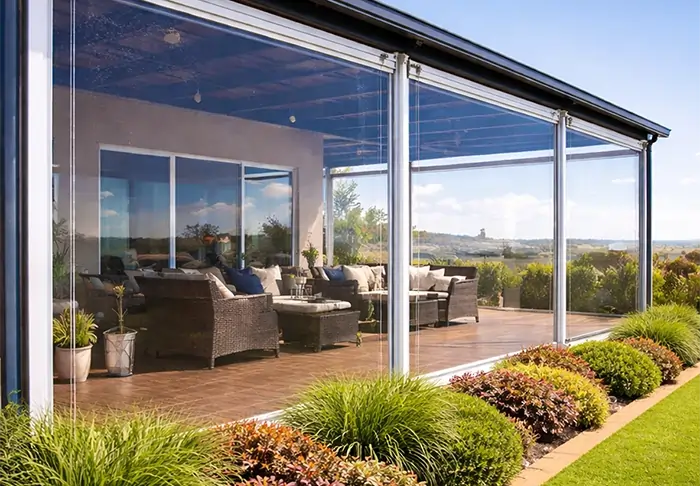
5. Roof-to-Fence Blinds (Angled Side Blinds)
📊 Key cost factors:
Span length and angle complexity can significantly affect pricing, especially since wider-angle drops require stronger tracks and arms. The fabric (mesh, blockout, or PVC), track requirements, site access, operation type, and custom framing, powder coating, and wind sensors can all add to the total roof-to-fence blinds cost.🏡 Common use cases:
These blinds provide side protection for patios, alfresco areas, and pergolas, thereby improving privacy by blocking neighbourhood views. They can also function as corner wind barriers and provide protection from sun glare and light wind while maintaining airflow. They’re popular for homes with tall fences or gutters and commercial poolside or courtyard areas that require angled coverage.✔ Pros:
Improved weather protection from multiple directions, maximise privacy on awkward angles without the use of posts, retract fully for an open feel, durable fabrics resist Aussie sun and wind, enhance usable outdoor space, and integrate well with track systems.❌ Cons:
Custom installation required, higher labour component and costs, requires solid roof and fence fixings, potential sagging without Ziplock tracks, and limited to side applications only.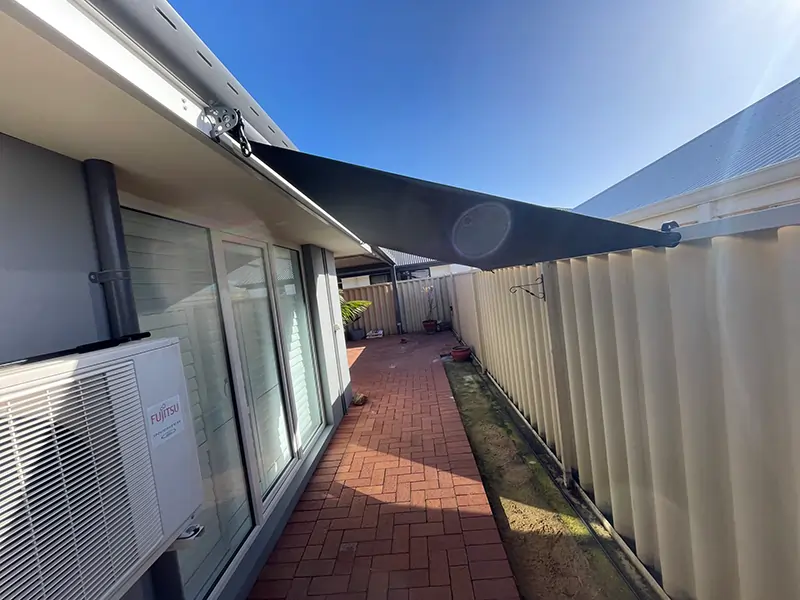
Angle-sided blinds are often paired with front-facing blinds to create a more complete outdoor enclosure, which should be factored into the overall project cost when planning a full perimeter solution.
Motorised vs Manual Blinds
Most outdoor blind types can be manual or motorised, and the decision to choose either option can significantly affect the total cost. Here, we answer the question: How much do motorised outdoor blinds cost?
So, if you’re still on the fence regarding your choice, the following table comparing the cost of motorised outdoor blinds with that of manual types might help.
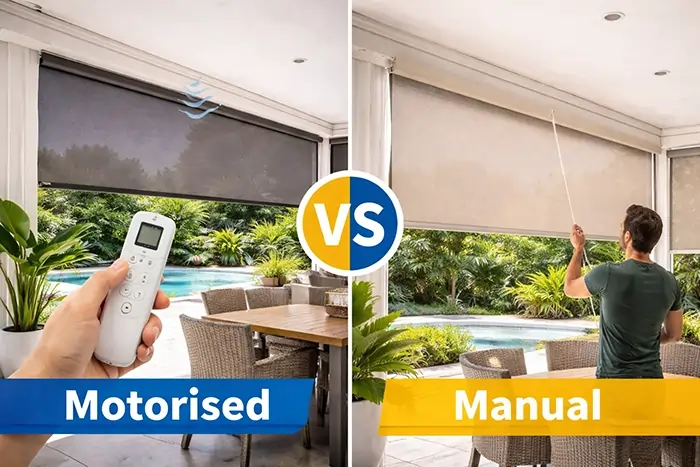
Still deciding between motorised and manual outdoor blinds?
Contact us now and we’ll guide you through the best option for your home.
| Factor | Manual | Motorised |
|---|---|---|
| Upfront cost (per blind) | AUD 1,500 to 4,000 | AUD 2,000 to 9,000 |
| Benefits | Simple, more affordable, low to no power dependency, child-safe cranks (no cords), and minimal upkeep for everyday reliability | Effortless, convenient remote/app control, timers and sensors for auto-adjust such as wind or sun, accessibility for the elderly or disabled, safety with no cords, compatibility with wind sensors and smart home systems |
| Best use cases | Suit smaller areas, low-use spots, off-grid installs, and budget-driven projects | Great for wide or heavy blinds, large alfresco areas with multi blind installations, smart homes, hard-to-reach spots, or if you want premium comfort and heavy usage where energy savings matter |
Installation Costs and Considerations
Once you understand the cost of the blind itself, installation becomes the next major piece of the puzzle. In our experience, this is where many budgets change unexpectedly.
DIY vs Professional Installation
DIY outdoor blinds from hardware retailers can look appealing because their price tags are lower. However, DIY systems are usually limited in size, wind rating, and customisation features. They also require accurate measuring, structural fixing, and weather sealing. If poorly installed, the blind can sag, leak, or fail in the wind.
Professional installation includes precise site measurements, correct mounting brackets, secure anchoring into brick, timber, or steel, and the proper alignment of tracks. For track-guided systems in particular, accurate installation makes a world of difference in terms of performance and lifespan.
Average Installation Costs
Across Australia, professional outdoor blinds installation costs typically range from AUD 250 to 800 per blind. But again, this range is quite broad as the final installation fee will depend on the size and complexity of the project. Larger track-guided or motorised systems can easily exceed this quoted range, especially if electrical work is required.
Challenges and Site-Specific Factors
Access can change everything. Second-storey balconies, tight side passages, uneven brickwork, or steel beams increase labour time, thereby affecting the overall cost. Wind-exposed sites may require additional bracing, while any additional work, like electrical wiring for motorised blinds, also adds to the total.
Key Factors That Influence Cost
When it comes to outdoor blind pricing, there are consistent factors that determine why one quote could be higher than another, even for similar-sized openings. Depending on the selections you make, these factors can add 20–100% to the base price of outdoor blinds.
PVC, mesh, and canvas have different price points. Clear PVC is generally more expensive than mesh because of its thickness and UV stabilisation feature. Premium woven mesh fabrics with higher UV block percentages cost more than entry-level alternatives, while the price of coated canvas would be based on the brand and treatment. In practical terms, upgrading to higher-grade materials can increase the overall blind cost by several hundred dollars per opening, particularly for larger spans. Thicker PVC or premium mesh options may also require stronger components or tracks, which can further influence the final installed price.
Higher-grade aluminium tracks, stainless steel fasteners, and premium fabrics such as Sattler, Visiontex, or Vistaweave cost more but last longer.
Cost vs Longevity
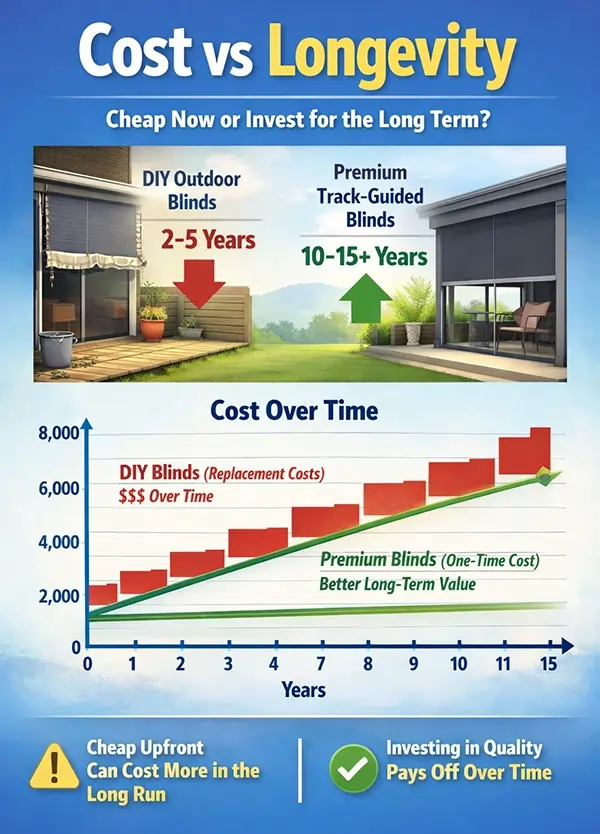
In their desire to ensure their budget fits, many buyers have a tendency to focus on the upfront price alone. But from our perspective as installers, longevity often matters more than the initial cost.
A cheaper blind that needs replacing in four years can cost more over time than a premium system that lasts 15 years or more. Here’s a table that illustrates this comparison:
| Blind Type | Estimated Lifespan | Typical Use Case |
|---|---|---|
| DIY outdoor blinds | 2 to 5 years | Temporary or low-exposure areas |
| Mid-range custom blinds | 8 to 12 years | Standard patios and alfresco areas |
| Premium track-guided systems | 10 to 15+ years | Exposed, high-use, wind-prone areas |
Why This Perspective Makes Sense
When price is viewed over the lifespan of the product, premium systems often represent better value per year of use. For example, an AUD 1,000 DIY blind lasting three years costs around AUD 333 per year. An AUD 3,000 premium blind lasting 12 years costs AUD 250 per year and performs better the entire time.
Where This Fits in Your Decision
This comparison should be considered alongside key cost factors. If your outdoor area is used frequently or exposed to wind, investing in a higher-grade system usually makes financial sense.
Outdoor Blind Costs by City
How are the prices of outdoor blinds in Perth? How about in Sydney or Melbourne?
Outdoor blind pricing varies slightly across major Australian cities due to variations in prevailing labour rates, demand, and local climate conditions. All prices in the following table are average ranges in AUD.
| Blind Type (Per Blind Installed) | Perth |
|---|---|
| Basic straight drop/roller | $400–1,200 |
| Track-guided manual (Ziptrak) | $800–3,000 |
| Motorised PVC/cafe | $1,200–3,000+ |
| Full alfresco (4 panels) | $5,000–12,000 |
Perth: Installation costs are typically moderate in Perth, where there’s strong demand for wind-rated and mesh blinds due to coastal conditions.
| Blind Type (Per Blind Installed) | Sydney |
|---|---|
| Basic straight drop/roller | $800–2,000 |
| Track-guided manual (Ziptrak) | $1,500–4,000 |
| Motorised PVC/cafe | $2,000–6,000 |
| Full alfresco (4 panels) | $10,000–25,000 |
Sydney: Labour costs are generally higher. Apartment balconies and strata approvals often increase installation complexity, and access challenges can raise pricing significantly.
| Blind Type (Per Blind Installed) | Melbourne |
|---|---|
| Basic straight drop/roller | $700–1,800 |
| Track-guided manual (Ziptrak) | $1,200–3,500 |
| Motorised PVC/cafe | $1,800–4,500 |
| Full alfresco (4 panels) | $8,000–18,000 |
Melbourne: Weather protection is a major focus. Installation costs are in the mid to higher range, primarily due to climate demands.
| Blind Type (Per Blind Installed) | Brisbane |
|---|---|
| Basic straight drop/roller | $700–1,900 |
| Track-guided manual (Ziptrak) | $1,300–3,800 |
| Motorised PVC/cafe | $1,900–5,500 |
| Full alfresco (4 panels) | $9,000–20,000 |
Brisbane: Shade and airflow are priorities, so mesh and straight drop blinds are common. Wind ratings may be lower in sheltered suburbs, which can reduce pricing slightly.
| Blind Type (Per Blind Installed) | Adelaide |
|---|---|
| Basic straight drop/roller | $600–1,700 |
| Track-guided manual (Ziptrak) | $900–3,200 |
| Motorised PVC/cafe | $1,400–4,200 |
| Full alfresco (4 panels) | $7,000–16,000 |
Adelaide: Similar conditions to Perth, though the demand for heavy wind-rated systems is slightly lower overall. Competitive installation fees help keep the price of outdoor blinds in Adelaide reasonable.
Most Common Buyer Mistakes
After years in the industry, we’ve seen similar mistakes repeated by our clients.

A blind that performs well in a sheltered courtyard may fail quickly on an exposed deck. The blind’s wind rating should match the site, not just the budget.

Mesh is excellent for airflow and sun control, but it doesn’t fully block rain. If you want to create a weather-resistant space, PVC is usually the better option.

DIY pricing often excludes custom sizing, structural fixing, and wind rating. Comparing an AUD 400 DIY blind to an AUD 2,000 installed track system is not comparing like for like.

Adding motors after installation can be expensive, so if automation is likely in the future, plan for it upfront.
By understanding these common pitfalls before you buy, you can choose a system that performs properly, lasts longer, and delivers better value over time.
Real-World Scenarios
Seeing how costs stack up in practical situations often makes pricing clearer. Check out the following scenarios:
Scenario 1: Budget Patio With Manual BlindsA standard suburban patio with three openings using manual straight-drop mesh blinds can cost about AUD 1,200 per blind installed and cost a total of about AUD 3,600. This provides shade and moderate wind protection without full enclosure.
Scenario 2: Premium Alfresco With Motorised ZiptrakIn a large alfresco with three wide openings using premium motorised track-guided mesh blinds, the cost per opening would be around AUD 3,500, including the electrical work, totalling about AUD 10,500. This kind of setup provides strong wind resistance, smooth operation, and year-round usability.
Scenario 3: Commercial Café With Clear PVC Drop BlindsFor a street-facing café, installing heavy-duty PVC drop blinds across four spans would cost approximately AUD 2,800 per opening, adding up to a total of around AUD 11,000. This system is designed to provide wind block and visibility for regular daily use.
OUTDOOR BLINDS COST FAQS
Frequently Asked Questions
DIY Spotlight outdoor blinds prices generally range from AUD 150 to 500, depending on the size and type. These are off-the-shelf products and don’t include professional installation.
There is no official IKEA outdoor blinds price. IKEA Australia offers budget-friendly (costing as little as AUD 7 to 10 for small SCHOTTIS pleated or block-out blinds) indoor roller and pleated blinds that some people repurpose as basic outdoor shades. Note that these are designed for light-duty residential use only and are ideal for temporary patio use (when the weather is generally pleasant), especially since they offer limited wind resistance.
Stratco outdoor blinds prices typically range from AUD 200 to 1,000 per blind (supply-only), depending on the style, fabric, and motorisation.
Mitre 10 DIY blinds are often cheaper upfront, usually costing between AUD 50 and 300. They are suitable for basic shade applications but not heavy wind exposure.
Outdoor roller blinds generally range from AUD 400 to 2,500 installed. Again, the actual price will depend on the fabric, size, and whether they are track-guided.
Outdoor canvas blinds prices typically range from AUD 1,000 to 2,500 installed. Premium treated canvas may cost more depending on the brand and coating.
Yes. Canvas roller blinds are usually less expensive than track-guided Ziptrak systems because they use simpler hardware and have lower wind ratings.
Mesh is often mid-range in price. The cost of canvas varies depending on the coating. Clear PVC is usually more expensive due to its thickness and weather resistance.
Not always. Many advertised prices exclude installation. Always confirm whether quotes are supply-only, or include measuring, fixing hardware, and labour.
Upfront, yes. However, custom blinds often last longer and perform better with the passage of time, making them more cost-effective.
Find the Right Outdoor Blinds for Your Space
Outdoor blind costs in Australia range from a few hundred dollars for basic DIY systems to several thousand dollars per opening for premium track-guided installations. Straight drop blinds cost less, while café and PVC systems fall in the middle range. Motorised track-guided blinds are more expensive but offer stronger, long-lasting performance.
To get the best value, match the blind type to the exposure level of your space and the expected usage frequency. Consider wind, rain, sun direction, and how often you will operate the blinds. Also, consider motorisation early rather than adding it later to save on costs.
Finding the right blind is not simply about considering which is the cheapest or the most expensive. Your best choice is the one that suits your structure, the climate, and your long-term plans for your space.
When chosen correctly and installed professionally, outdoor blinds can transform how often and how comfortably you’ll be using your outdoor space.
Need inspiration and expert advice in selecting the right outdoor blinds?
Check out our gallery or get in touch with Outdoor Shades WA today!
Free Measure & Quote
Contact us to discuss your options and arrange for a free, no-obligation measure and quote anywhere in Perth.