
If you are wondering how to enclose a patio, outdoor blinds offer a practical place to start. They can provide greater protection from Australia’s strong sun, changing winds, light rain and insects without the commitment of building permanent walls.
Among the many ways to enclose a patio, blinds offer the flexibility to open the area in pleasant weather and lower them when additional coverage is needed.
In this guide, I’ll walk you through the main patio enclosure options, including planning, blind systems, fabrics, measurements and installation. These practical patio enclosure ideas will help you create a more comfortable and usable outdoor living area.
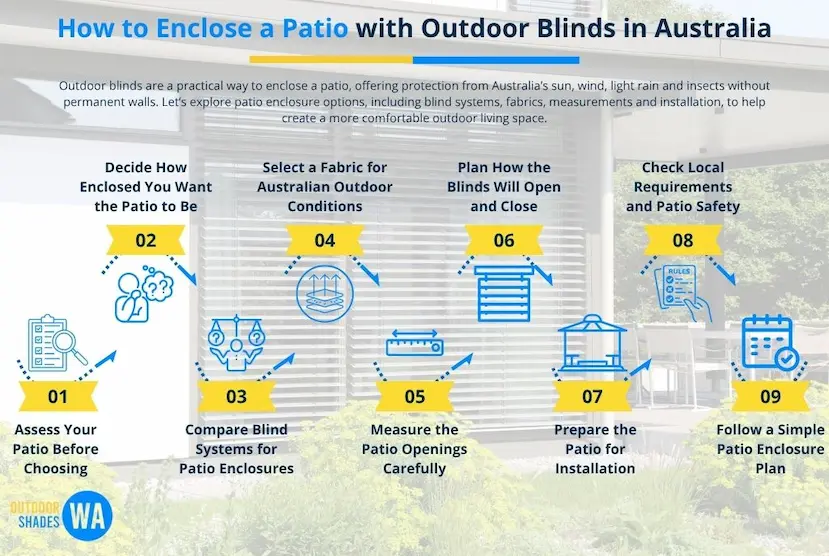
Assess Your Patio Before Choosing an Enclosure
When deciding how to enclose a patio, I always suggest looking at how the space behaves throughout the day, rather than just when the weather is calm.
Start with these practical questions:
- How large is the patio, and which sides are open?
- Are the roof, posts and beams suitable fixing points?
- Where does the strong afternoon sun enter?
- Which direction brings wind and rain?
- Do you want privacy without losing the view?
- How much airflow would keep the area comfortable?
- Will the blinds remain lowered or be opened regularly?
The wind is an important factor in Perth. The renowned afternoon sea breeze, famous in the region, can invade from the coast, explains the Bureau of Meteorology. So, what works best for your home on one side may not be the best for the other.
As you’re searching for patio enclosure options, Outdoor Shades WA takes into account doors, uneven flooring and obstructions around every opening. Looking at the various types of outdoor blinds will help you compare functional ways to enclose a patio while still keeping it breezy, visible, and easy to access.
Decide How Enclosed You Want the Patio to Be
Before you begin deciding on how to enclose a patio, you should think about how much protection you need. The best way to enclose a patio is not always to cover every opening. It will depend on the manner of use and where the weather enters.
Partial Enclosure
If solar, wind and/or mostly rain infiltrate the house from a single source, only one or two sides might suffice.
Full Flexible Enclosure
If you need to use your patio for dining, entertaining, or normal use year-round, you may want to enclose a patio with blinds across most or all open sides. They can be lowered when required and opened when fresh air is needed.
Shade-Only Options
An awning is a projecting cover that gives a shaded area or slanted shade, but usually doesn’t close the sides of the patio. For applications where full enclosure is not important, but adjustable shade is, folding arm awnings should be considered.
Your Home suggests adjusting the shading to provide sun protection while still allowing daylight and views. When selecting an awning, check the clearance needed for a retractable awning to ensure that there is sufficient arm length, pitch, and movement.
Compare Outdoor Blind Systems for Patio Enclosures
Look at each opening separately. One system doesn’t have to be installed in a single area. It will vary depending on the layout of the patio, fixing points and exposure to Perth’s variable weather conditions.
| Blind System | Best suited to | Main Advantage | Enclosure Level |
|---|---|---|---|
| Ziptrak Blinds | Wide, exposed patio openings | Wide, exposed patio openings | High |
| Roof-to-Fence Blinds | Narrow areas between a patio and boundary fence | Protects an opening that standard vertical blinds may not suit | Moderate to High |
| Straight Drop Blinds | Simple openings mainly needing sun and glare control | Minimal hardware and straightforward operation | Moderate |
Which System Fits Your Patio?
Track-guided blinds typically provide the most enclosed look when they’re used to enclose a patio. They have edges that run within side channels, which contribute to minimising the open gaps present in unsupported designs.
Another easy-to-use choice is straight drop blinds. They descend vertically, not with enclosed side tracks; therefore, there are typically small gaps around the edges. I recommend these when the need for shade, visibility and ease of use outweighs the need for close side coverage.
Roof-to-fence blinds can protect an awkward side opening, but their suitability depends on:
- The distance between the roof and fence
- Fence height and position
- Available structural fixing points
- The direction of incoming sun, wind and rain
For openings that differ in width, angle or exposure, we may suggest some mixing of systems. The configuration that fits with the existing structure is the best way to enclose a patio.
Select a Fabric for Australian Outdoor Conditions
Don’t just choose the fabric based on colour alone when deciding to enclose a patio. It will affect the amount of shade, privacy, airflow, and outward control you have, and how the enclosure will handle the weather.
Mesh Fabrics
Outdoor mesh can maintain that open-air experience while minimising glare and direct sunlight. Various degrees of openness allow you to use either visibility or coverage as a priority:
- A more open weave allows greater airflow and clearer views.
- A tighter weave provides increased shade and daytime privacy.
- Darker colours often make outward views easier to maintain.
- Performance can vary with the sun’s angle and lighting conditions.
When enclosing a patio with blinds, it’s important to consider two types of materials: Vistaweave and Visiontex. This is dependent on the orientation of the patio and the exposure of each patio opening.
Acrylic Awning Fabrics
Acrylic fabric is perhaps better if you are looking for good overhead shade and colour. It is commonly used on awnings and can be applied to specific outdoor blind applications. One fabric that homeowners may come across is Sattler.
According to the Australian Radiation Protection and Nuclear Safety Agency (ARPANET), shade fabrics can be given an Ultraviolet Effectiveness rating according to Australian Standard AS 4174:2018.
Measure the Patio Openings Carefully
When it comes to enclosures, getting it right is critical. Don’t assume the size of two openings is the same, even if they appear to be the same. The regulation of the posts, beams or floor can create slight differences that impact the smoothness of the blinds rolling.
Measure Each Opening Separately
For enclosing a patio with blinds, follow this process:
- Identify and number every opening you want to cover.
- Measure the width across the top, middle and bottom.
- Measure the drop on the left, centre and right.
- Check whether the posts are vertical and the beams and floor are level.
- Record nearby handles, lights, gutters, downpipes and doors.
- Identify suitable fixing areas for brackets, side tracks and bottom rails.
- Write down each measurement separately in millimetres.
Use a suitable metal tape measure and get someone to hold the opposite end over wider spaces. Always measure twice. If there is variation, don’t just use an average, as the blind must accommodate the actual opening.
Look Beyond Width and Height
The WA Guide to Standards and Tolerances acknowledges that there can be measurable variations in floors and posts, and other building components. Older patios can even be more irregular because of movement, settlement or former changes.
Before we make a recommendation to our customers for patio enclosure options, we will check these details. If the opening is not level, consider customising the size, packers or extra framing. The wrong measurements can result in gaps, strain on blinds and prevent a track-guided system from functioning correctly.
For the most reliable fit, arrange professional measuring before placing the final order.
Plan How the Blinds Will Open and Close
Consider how often you need to change the blinds. The easiest system to use is usually the one you will use properly.
Choose a Practical Operating System
At Outdoor Shades WA, we typically consider:
- Manual operation for smaller blinds or openings used occasionally
- Crank operation for larger blinds that need extra leverage
- Motorised outdoor blinds for wide openings, multiple blinds or frequently used patios
It can be easier to enclose a patio with blinds if it is motorised, especially when each blind needs adjusting as the sun or weather changes. Determine if blinds are to be operated singly or in unison; place controls in an out-of-the-way but easily-accessed location.
When installing, make sure there is no interference with the blinds and their bottom rails, like doors, furniture, or barbecues.
In extreme weather, it may be necessary to completely raise some of these systems rather than leaving them part-way up. When damaging winds are expected, adhere to the manufacturer’s operating restrictions and listen to official Emergency WA warnings. Do not use a blind when the situation presents a hazard to outside use.
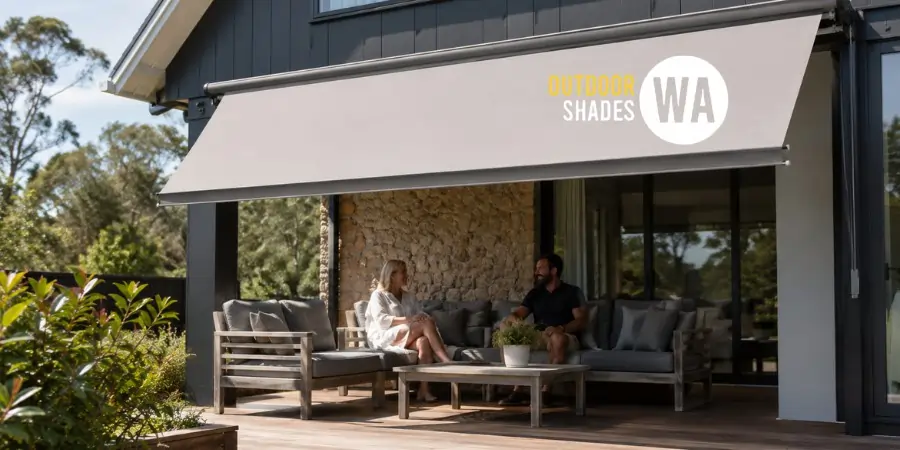
Prepare the Patio for Installation
After you have decided on your patio enclosure, you have to ensure that the structure is ready. With good preparation, the blinds can be made to fit properly, glide easily and cover uniformly around openings.
Complete These Checks Before Installation
Before fitting begins, I recommend checking the following:
- Confirm that posts, beams and patio framing are sound.
- Repair damaged timber, loose masonry or corroded components.
- Add suitable fixing points if the existing structure cannot support the brackets or tracks.
- Clear furniture, barbecues, plants and other obstacles from the work area.
- Check that gutters and downpipes carry rainwater away effectively.
- Make sure doors and windows can open without striking the blinds.
- Allow adequate room for headboxes, side tracks and bottom rails.
- Plan a suitable power supply and sheltered control location for motorised blinds.
Drainage can easily be overlooked when enclosing an outdoor patio. The City of Gosnells’ stormwater guidance explains that property owners are responsible for managing stormwater runoff within their property. Check for blocked gutters, poor falls or areas where water pools before the enclosure is fitted.
Accurate Fitting Matters
At Outdoor Shades WA, we pay particular attention to alignment when installing track-guided blinds. If the tracks are not straight and parallel, the blind could bind, move unevenly or leave gaps around the edges.
Professional outdoor blinds installation is worth considering when the patio has:
- Wide or unusually shaped openings
- Uneven posts, beams or flooring
- Significant exposure to wind
- Motorised components
- Limited or uncertain fixing points
While preparing a patio enclosure may not be the most fun, it is an important aspect of a well-balanced and reliable enclosure.
Check Local Requirements and Patio Safety
If you are considering enclosing a patio, I recommend checking the rules that apply to your property before deciding how it should be enclosed. The requirements vary from council to council, and flexible outdoor blinds may differ from alterations to existing frames or structures.
Check Before You Order
At Outdoor Shades WA, we encourage homeowners to confirm:
- Whether planning or building approval is required
- If strata or body corporate permission applies
- Whether the installation affects common property
- That doors, controls and moving parts remain safely accessible
- That cords are secured away from children and pets
The City of Perth recommends that building permits are normally needed for alterations or improvements to a building. The rules may be different; please check with your local council before changing the patio.
For townhouses and apartments, Landgate says that some renovations in strata schemes may need strata company approval.
If the patio enclosure options you are considering have a powered blind or new fixed wiring, these must be installed by a qualified electrician per the WA regulations.
Follow a Simple Patio Enclosure Plan
If homeowners contact me about how to enclose a patio, I always suggest that they make one decision at a time. A straightforward plan helps avoid missed measurements, inappropriate materials, and unforeseen installation problems.
Your Patio Enclosure Checklist
- Identify which sides need protection from sun, wind, rain or overlooking.
- Choose a partial enclosure or flexible coverage across all open sides.
- Compare blind systems based on the openings and desired coverage.
- Select a fabric that balances shade, airflow, privacy and visibility.
- Measure every opening and locate secure fixing points.
- Decide between manual, crank or motorised operation.
- Check drainage, power access and clearance around doors and furniture.
- Confirm any council or strata requirements.
- Arrange supply and professional installation where appropriate.
- Test each blind and read its care and severe-weather instructions.
The Building and Energy guidance from Western Australia suggests seeking clarification from your local government regarding any approvals and local laws that apply.
At Outdoor Shades WA, we use this to turn patio enclosure ideas into a reality that fits the home precisely. The best way to enclose a patio is one that fits the structure, reacts to the weather conditions, and is easy to use.
Final Thoughts
Learning how to enclose a patio does not mean permanently giving up its open-air character. Outdoor blinds let you enjoy greater protection when needed, then reopen the space when the weather is pleasant.
The right solution depends on your patio structure, weather exposure, preferred fabric, blind system and installation quality. Custom measurements, motorisation or structural changes may also require professional guidance.
Outdoor Shades WA can assess your patio and recommend practical patio enclosure options for your home.
Ready to make your patio more comfortable year-round? Contact us for personalised advice and a free quote.