How do retractable awnings work?
Understanding what an awning is starts with its basic structure and operation. Retractable awnings work by rolling a fabric canopy in and out from a wall-mounted or roof-mounted frame. When extended, the folding arms support the fabric and keep it under tension. When retracted, the fabric rolls back into the housing or cassette to protect it from sun, rain, wind, and debris.
Some awnings use a manual crank, while motorised models use a remote, wall switch, sensor, or smart home control.
In Australia, especially here in Western Australia, where the sun can be intense, these systems have become a go-to for improving outdoor comfort.
I have worked with outdoor blinds across Perth for years, and I’ve seen just how much a well-installed awning can make a difference to a home.
That said, retractable awnings aren’t the only option.
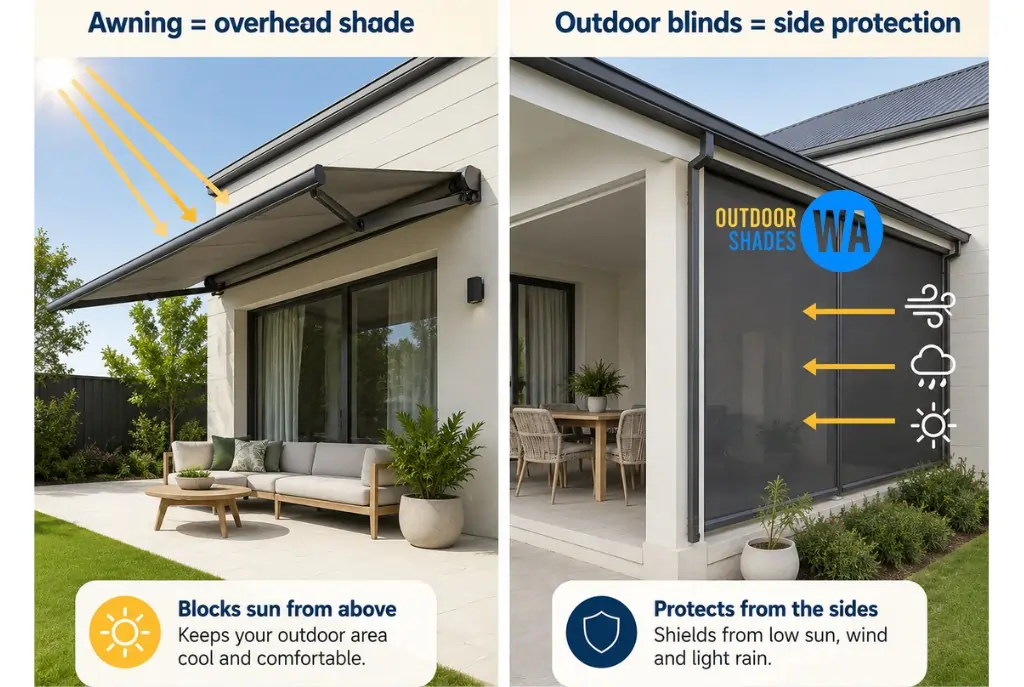
Compared to other types of outdoor blinds, awnings are primarily designed for overhead protection, while the others are better suited for blocking wind, rain, and low-angle sun.
Both have their place, and choosing between them often comes down to how you use your space.
In this detailed guide, I’ll walk through everything from retractable awning basics and how they operate, to the different types, features, and how they compare with other outdoor shading systems.
Key Takeaways
- Retractable awnings provide overhead shade for patios, decks, and alfresco areas.
- Manual awnings use a crank handle, while motorised awnings use an electric motor.
- Folding arms keep the fabric extended and tensioned.
- Full cassette awnings offer the most protection when closed.
- Awnings are best for sun protection, while outdoor blinds are better for wind, rain, and enclosure.
How Do Retractable Awnings Work?
To grasp how retractable awnings operate, it is essential first to understand the fundamental concept: the flexible fabric cover moves in and out with the help of a mechanical arm, either operated electronically or manually by a motor.
Here’s a clear breakdown of how retractable awning works.
Activation of the system can be done either by manual crank or motorised control, which is key to how awnings operate.
In manual systems:
- Turning the handle engages a gearbox.
- The rotation drives a roller tube, allowing the fabric to unroll smoothly outward.
- Folding arms extend simultaneously, supporting the fabric as it moves.
- Internal spring tension keeps the fabric tight and stable during extension.
- When retracting, the process reverses.
In motorised outdoor blind systems:
- A small electric motor replaces the manual crank, streamlining the entire awning operation process.
Another key element in how awnings function is their self-protection. The fabric is rolled back onto a tube when not in use, often contained in a cassette.
This design shields the material from the sun, rain, and debris which makes this outdoor blind ideal to reduce heat.
It’s a simple system, but when installed properly, it can make an outdoor area much more comfortable.
After you get the gist of it, you will see why retractable awnings continue to be a favourite among Australian houses.
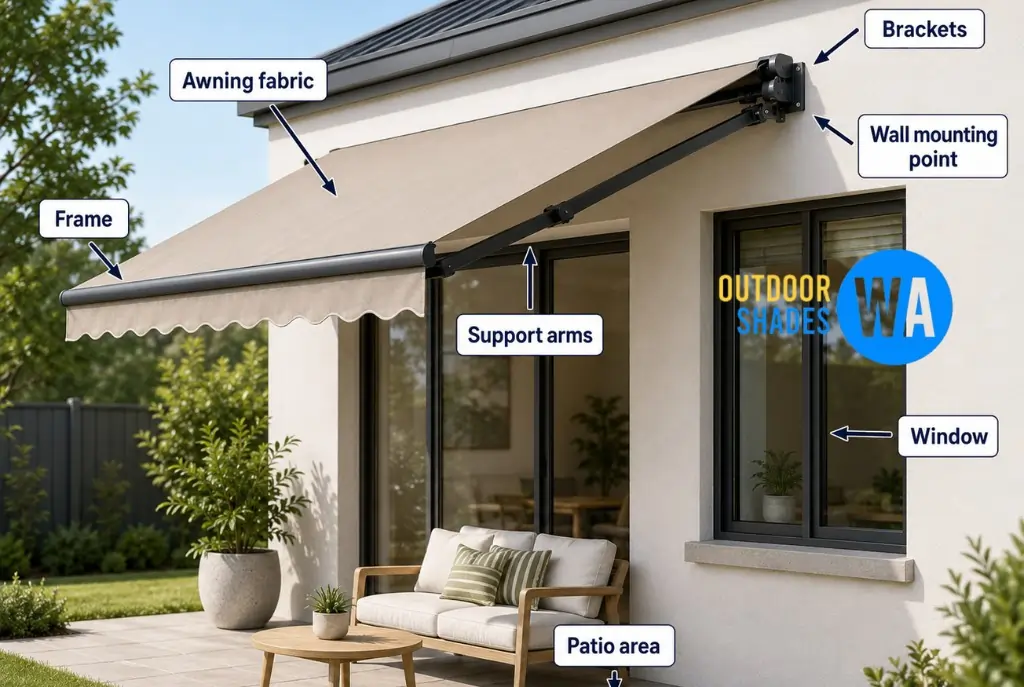
Main Parts of a Retractable Awning
| Part | What It Does |
|---|---|
| Fabric Canopy | Provides shade and UV protection |
| Roller Tube | Rolls the fabric in and out |
| Folding Arms | Support the fabric when extended |
| Brackets | Secure the system to the wall, roof, or beam |
| Cassette | Protects the fabric and arms when closed |
| Motor or Crank | Controls extension and retraction |
Retractable Awnings Arm Types & Their Function
One of the crucial parts of any awning system is the arms. They control how the awning extends, how stable it is, and how well the fabric stays tensioned.
Arm types are important in understanding how retractable awnings work since they do most of the heavy lifting.
Arm Types and How They Work
Various retractable awnings have different arm designs, and each is suited to a specific application. Here’s a breakdown of the most common types are a breakdown of:
| Arm Type | How It Works | Key Benefits | Best Use Case |
|---|---|---|---|
| Folding Arm (Articulated Arm) | Spring-loaded arms extend outward in sections, maintaining fabric tension | Smooth operation, no vertical posts, wide coverage | Patios, decks, alfresco areas |
| Telescopic Arm | Extends in a straight, sliding motion rather than folding | Compact design, controlled extension | Smaller spaces or windows |
| Lateral Arm | Similar to folding arms but designed for larger projections | Strong support for wider spans | Large outdoor entertaining areas |
| Drop Arm | Arms pivot downward to guide vertical fabric movement | Better control for angled shade | Windows and balconies |
Quality arm systems should be designed to ensure uniform tension throughout the projection, which enhances durability and appearance.
The Function of Awning Arms
The awning arms are not just extensions of the fabric; they also contribute to stability, tension, and the flow of motion.
Checking that the awning frame is strong and that the arms move smoothly without twisting, as this supports better operation and long-term performance.
Arm Strength and Wind Performance
Arm strength is significant to the performance of an awning in outdoor conditions. Sturdier arms are more resistant to movements and vibrations.
It should be noted, though, that even the most powerful arms are not made to withstand extreme weather. It is always necessary to retract the awning in high wind to protect the system.
How Arm Design Impacts Performance
The type and quality of the arms influence everything from projection distance to longevity.
- High-quality arms provide smoother extension and retraction
- Better tension systems reduce fabric sagging
- Stronger joints improve long-term durability
To put it simply, everything in the system is efficient due to the arms, without which, the retractable awning operation would not be effective.
Retractable Awnings Functionality Options
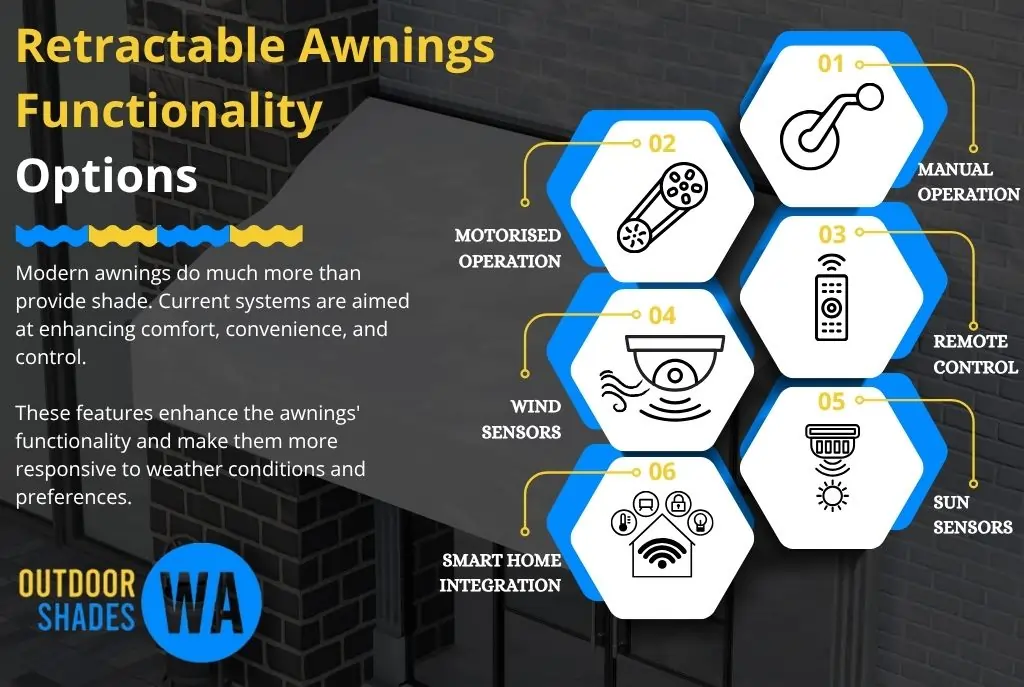
Modern awnings do much more than provide shade.
From manual operation to smart automation, current systems are aimed at enhancing comfort, convenience, and control.
Key Functionality Options
Here’s a breakdown of the most common functionality features available:
| Feature | How It Works | Key Benefits | Best For |
|---|---|---|---|
| Manual Operation | Hand crank rotates the roller tube to extend/retract | Cost-effective, simple, no electricity required | Smaller areas, budget-conscious setups |
| Motorised Operation | Electric motor controls extension via switch or remote | Convenience, smooth movement | Everyday use, larger awnings |
| Remote Control | Wireless control for easy operation | Quick adjustments without effort | Alfresco and entertaining areas |
| Wind Sensors | Automatically retracts awning in strong winds | Protects system from damage | Wind-prone areas |
| Sun Sensors | Extends awning when sunlight is detected | Passive cooling and comfort | North- or west-facing spaces |
| Smart Home Integration | Connects to apps or home automation systems | Full control and scheduling | Modern Smart Homes |
These features enhance the awnings’ functionality and make them more responsive to weather conditions and preferences.
Weather-Responsive Features
Advanced systems have added automation based on environmental conditions.
Awnings can automatically be retracted during strong winds by wind sensors and extended when required by sun sensors.
These features significantly contribute to how retractable awnings work in modern homes, lessening the need for manual adjustments and helping safeguard the system against unforeseen weather patterns.
Choosing the Right Functionality
The right features are based on your lifestyle and environment.
For occasional use, a manual system can suffice. However, motorised and automated options are more convenient and offer greater protection when used frequently or in larger outdoor areas.
Ultimately, functionality upgrades improve the overall experience, transforming a simple shading system into a smart, responsive solution tailored to your needs.
Retractable Awnings Variations
Although all systems are similar in principle, the design, mounting style, and degree of protection can vary greatly depending on your space and requirements.
- Folding Arm Awnings: The folding arm awning is the most common style in Australian houses. This is typically the system within a normal patio environment.
- Cassette vs Semi-Cassette vs Open Styles: The other main difference in awning operation basics is in the protection of the awning when closed:
- Full cassette awnings fully cover the cloth and poles, and provide the greatest resistance to weather.
- The system is partially covered with semi-cassette awnings, which normally shield the top of the cloth.
- Open awnings have the fabric exposed when closed, meaning they are cheaper but less protective. For this reason, choosing the best fabric for outdoor awnings becomes even more important when the material is exposed between uses.
- Roof-Mounted vs Wall-Mounted Systems: Another significant factor in how retractable awnings work in various environments is the installation style.
- The most common are wall-mounted awnings, which are connected to the outside wall.
- Roof-mounted awnings are attached to rafters or eaves, where there is little wall space.
These variations can help you to better match the correct system to your space by determining how much you value open views, maximum protection, or a combination of both.
How Much Space and Clearance Is Needed for Retractable Awnings?
When installing an awning, it is worthwhile to know the space requirements to ensure smooth, long-lasting operation.
Understanding the space required to install a retractable awning prevents problems with height, projection, and structural reinforcement, especially in Australian homes where outdoor space sizes and designs are diverse.
Installation Considerations (Height, Projection, Angle)
To ensure the setup is correct, three important variables to consider are mounting height, projection, and pitch (angle).
These factors directly affect how retractable awnings perform in real-world conditions.
- Height: Awnings are normally mounted at least 2.5–3 metres above the ground to ensure the head can move freely when extended.
- Projection: This refers to how far the awning extends outward—larger projections require more open space in front
- Angle (Pitch): A slight downward angle is necessary for water runoff and effective shade coverage
These adjustments are part of how awnings operate, ensuring the system provides shade without obstructing movement or allowing water to pool on the fabric.
Structural Support Requirements
Awnings may appear lightweight, but they exert significant pressure on the surface where they are mounted.
This is a very important aspect because the brackets should be able to withstand the system’s weight and the forces generated when extending it and when exposed to wind to stop the blinds from banging.
Proper bracket placement and secure fixing into suitable structural supports are essential, as folding arm awnings place significant force on the mounting surface when extended.
Retractable Awnings vs Other Outdoor Blinds
When comparing outdoor shading systems, one can assess their performance in real-world applications.
Retractable awnings and vertical blind systems are the same in that they enhance comfort outside, just in very different ways, depending on your space and way of life.
Key Differences in Function and Design
Retractable awnings create overhead shade as they extend horizontally, while other outdoor blinds cover an area as they extend vertically.
Here’s a clearer breakdown:
| Feature | Retractable Awnings | Ziptrak Blinds | Roof-to-Fence Blinds | Straight Drop Blinds |
|---|---|---|---|---|
| Main Function | Overhead sun shade | Enclosed outdoor “room” | Full vertical enclosure | Simple vertical drop shade |
| Direction of Operation | Horizontal extension | Vertical track-guided system | Vertical fixed guide system | Vertical free-hanging drop |
| Weather Protection | Good sun protection | Strong wind and sun protection | High enclosure & wind control | Moderate wind and sun protection |
| Rain Protection | Limited (not waterproof when open) | Good (especially with sealed tracks) | Good coverage depending on install | Basic to moderate |
| Space Feel | Open air living | Semi or fully enclosed space | Enclosed outdoor area | Flexible open or semi-open |
| Best Use Case | Patios, decks, alfresco dining | Outdoor “rooms” and privacy areas | Boundary-to-roof enclosures | Simple balconies or patios |
The main difference is function: awnings create overhead shade, while outdoor blinds help enclose and protect an outdoor area from the sides.
When to Choose Awnings vs Other Outdoor Blinds
The right system is determined by how you will use your outdoor area and the level of protection you require.
Retractable awnings are ideal when you want flexibility and open-air living.
They are perfect for patios, decks, and other outdoor areas where you need some protection but still want air to pass through, see the views, and get an open feel.
On the other hand, Ziptrak blinds are recommended if you want to cover the entire outdoor area.
They are usually applied to outdoor dining areas or patios where wind resistance and privacy are concerns.
They are sealed in side tracks, providing a far more secure environment than awnings.
Roof-to-fence blinds are often used to cover the boundaries, ideal for sealing up vast open spaces between a roofline and a fence.
This makes them handy for providing privacy in suburban backyards or for deterring exposure to harsh side winds.
Straight drop blinds are a simpler type of blind commonly used on balconies or smaller patios.
They are simpler to install in vertical coverage, do not have the complete sealing of Ziptrak or roof-to-fence systems, are less expensive, and more versatile.
Your climate and lifestyle are the major factors that will determine your home decisions.
In hot, sunny climates, awnings are more welcome for cooling and shade, whereas in windy or exposed places, it is more practical to have an enclosed system such as Ziptrak or waterproof outdoor blinds.
Choosing the Right Outdoor Shading Solution for Your Space
With a simple system of folding arms, tension springs, and a rolling fabric tube, retractable awnings provide flexible, on-demand shade while still allowing you to enjoy an open outdoor area.
What makes retractable awnings stand out is their versatility. They can be tailored to suit different layouts, lifestyles, and levels of sun exposure.
The right solution really depends on how you use your space.
Some homes benefit most from the open, overhead shade of a retractable awning, while others may need a combination of systems to create a more enclosed and weather-protected area.
At Outdoor Shades WA, we install folding-arm awnings and a range of outdoor shade solutions designed for Australian conditions.
If you’re planning to upgrade your outdoor area, feel free to get in touch with our team to explore the best options for your space.